










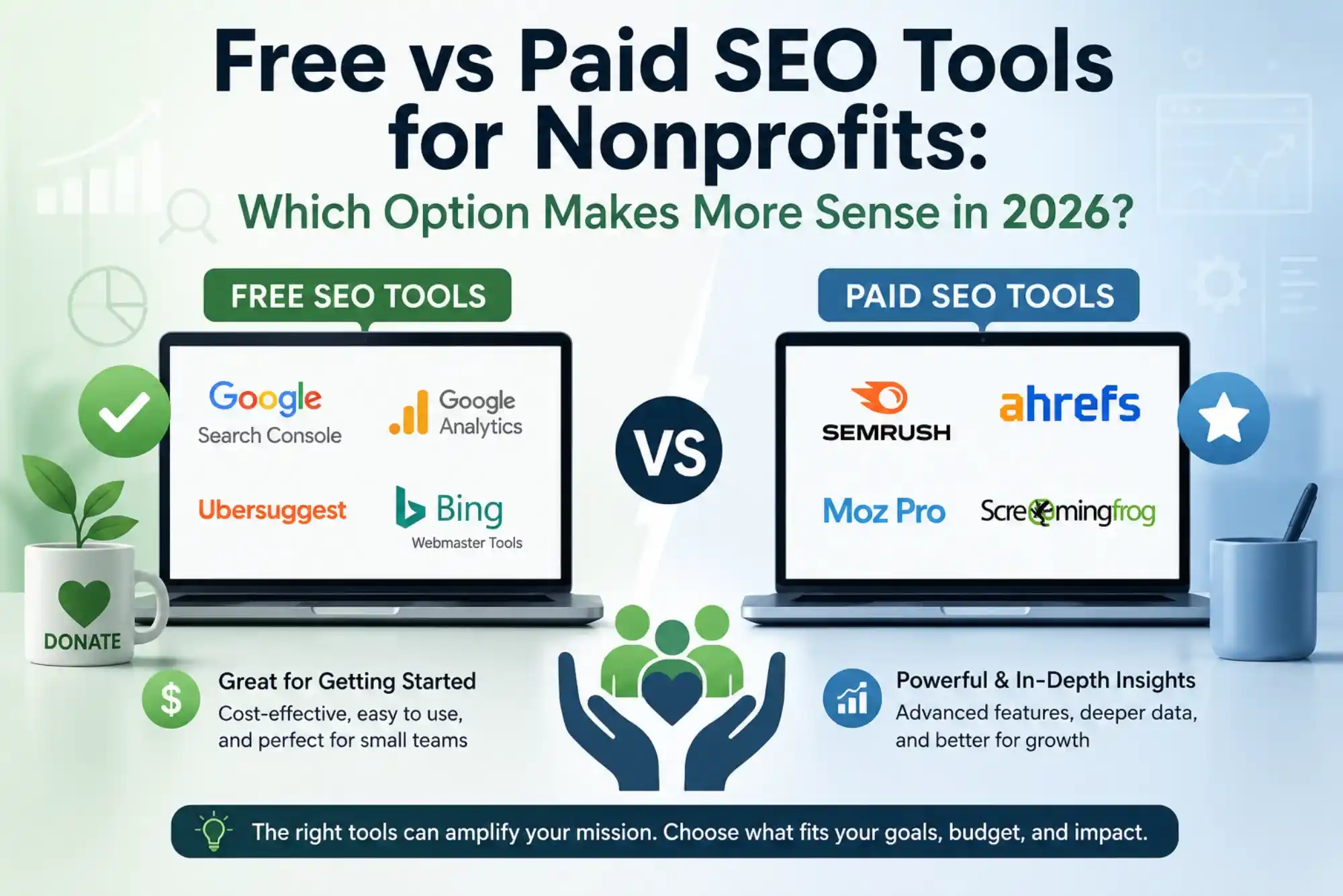
Free vs Paid SEO Tools for Nonprofits: The Short Answer
The best choice depends on the nonprofit’s size, goals, technical skills, and content workload. Free tools can cover essential tasks such as monitoring search performance, checking indexing issues, reviewing website traffic, and conducting basic keyword research. Paid tools generally provide broader keyword databases, competitor intelligence, rank tracking, content analysis, backlink research, and more efficient workflows.
For a small nonprofit with a limited marketing budget, paying for an expensive all-in-one SEO platform may not produce enough additional value to justify the cost. A larger organization publishing content regularly or competing for high-value search terms may save substantial time with premium software. The decision should therefore be based on measurable needs rather than the assumption that paid automatically means better.
Why SEO Tools Matter for Nonprofits
Nonprofits often operate with limited resources, making organic search particularly attractive. A strong search presence can help an organization reach people looking for information, support, educational resources, volunteer opportunities, donations, or services without paying for every visit through advertising.
SEO tools make that work more manageable by helping teams understand how their websites perform in search engines. Instead of guessing which topics people care about, a nonprofit can use data to identify relevant queries, discover technical problems, evaluate content performance, and measure progress over time.
The challenge is that nonprofit teams frequently have competing priorities. A communications manager may also handle social media, fundraising campaigns, newsletters, website updates, and public relations. In that environment, the right SEO tool is the one that makes important work easier without consuming an unreasonable share of the budget or staff time.
What Can Free SEO Tools Do?
Free SEO tools are more capable than many nonprofit teams realize. Several essential SEO activities can be handled without paying for a premium subscription, particularly when an organization has a relatively small website and a focused search strategy.

Monitor Search Performance
Free webmaster and search performance platforms can show which queries bring users to a website, which pages receive impressions, and how pages perform in organic search. This information is valuable for identifying content that already has visibility but could improve with better titles, clearer answers, stronger internal links, or more comprehensive information.
Find Technical Problems
Free tools can help teams identify issues involving indexing, mobile usability, broken pages, page experience, and other technical factors. These insights are particularly useful for nonprofits that manage their own websites and need to prioritize fixes without hiring an SEO agency for every small problem.
Research Basic Keywords
Free keyword research resources can provide useful starting points for discovering topics and search phrases. A nonprofit can combine these insights with knowledge of its audience to build content around questions that genuinely matter to the communities it serves.
Understand Website Traffic
Analytics platforms can help organizations understand where visitors come from, which pages they view, and what actions they take. For nonprofits, this is especially important because traffic alone is not the ultimate goal. A page that attracts fewer visitors but generates volunteer applications, donations, event registrations, or resource downloads may be more valuable than a high-traffic page that produces no meaningful action.
Advantages of Free SEO Tools
The biggest advantage is obvious: they reduce financial barriers. A nonprofit can establish a basic SEO measurement system without committing to another recurring software expense.
- Low financial risk: Teams can learn SEO without immediately purchasing a subscription.
- Good for small websites: Organizations with limited content often have fewer data requirements.
- Useful for beginners: Free platforms are often sufficient for learning the fundamentals.
- Easy to combine: Several free tools can be used together to cover different SEO tasks.
- Better budget allocation: Money can remain available for content creation, accessibility, website improvements, or outreach.
Free tools can also encourage a more disciplined approach. When a team has limited data, it may focus on a smaller number of meaningful questions instead of becoming overwhelmed by hundreds of SEO metrics.
Where Free SEO Tools Fall Short
The main weakness of free SEO tools is not always a lack of basic functionality. It is often the lack of depth, scale, and convenience.
For example, a nonprofit may be able to identify keywords through free resources, but a paid platform might make it much easier to compare thousands of related terms, examine competitors, estimate ranking difficulty, monitor positions, and organize opportunities in one place.
Free tools may also impose limits on the number of searches, reports, tracked keywords, projects, or historical data available. When an SEO program becomes more sophisticated, moving between several separate platforms can create additional work.
Another issue is time. A small nonprofit might save money by using five free tools, but if staff members spend several hours every month manually combining information, the apparent savings may be less meaningful. Staff time is a real organizational cost, even when it does not appear as a software invoice.
What Do Paid SEO Tools Offer Nonprofits?
Paid SEO platforms are designed to bring more data and workflow capabilities into a single environment. Depending on the provider and subscription level, a premium platform may include keyword research, competitor analysis, rank tracking, backlink monitoring, technical audits, content recommendations, and reporting.
The greatest value often comes from combining these functions. Instead of collecting information from multiple sources, an SEO professional can move from identifying an opportunity to researching competitors, planning content, monitoring rankings, and reporting results within one workflow.
Deeper Keyword Research
Paid databases generally provide more extensive keyword information than basic free resources. This can help nonprofits identify long-tail queries, related topics, search trends, and opportunities that may otherwise remain hidden.
This matters when an organization is trying to reach a very specific audience. A nonprofit working in a specialized field may need to understand a large set of closely related searches before deciding which topics deserve dedicated pages.
Competitor and Industry Research
Premium tools can help nonprofits study websites competing for the same search visibility. Competitors do not have to be other nonprofits. Depending on the topic, a nonprofit may compete with government websites, educational institutions, media organizations, commercial businesses, or community resources.
Understanding which pages already perform well can reveal gaps in an organization’s own content strategy and help teams create genuinely more useful resources.
Rank Tracking
Tracking selected keywords over time can make SEO progress easier to evaluate. This is particularly useful for nonprofits running ongoing campaigns around awareness, education, fundraising, or public policy.
However, rankings should never become the only success metric. Search visibility should ultimately connect to meaningful outcomes, such as qualified visitors, resource usage, event participation, volunteer activity, or donations.
Backlink and Authority Research
Links from relevant and trustworthy websites can contribute to a site’s ability to earn search visibility. Paid tools can make it easier to investigate a website’s backlink profile and identify potential outreach opportunities.
For nonprofits, this might include partnerships with educational institutions, community organizations, professional associations, journalists, resource directories, and relevant publications. The goal should be genuine relationships and useful resources rather than acquiring links simply for SEO.
Reporting and Workflow Efficiency
When multiple people contribute to content or marketing, paid tools can help centralize SEO tasks. Reporting features can also make it easier to explain progress to leadership, board members, funders, or stakeholders.
This can be especially useful when SEO is part of a broader digital strategy. A nonprofit may need to demonstrate not only that search visibility improved, but also how that improvement contributed to organizational objectives.
Free vs Paid SEO Tools: Key Differences
| Factor | Free SEO Tools | Paid SEO Tools |
|---|---|---|
| Cost | Little or no direct software cost | Recurring subscription or annual expense |
| Keyword research | Suitable for basic research | Broader databases and advanced analysis |
| Competitor research | Usually limited | Generally more detailed |
| Rank tracking | Often limited or requires manual work | Automated monitoring is commonly available |
| Technical SEO | Good for essential checks | More advanced auditing and reporting options |
| Backlink analysis | Basic visibility may be available | Deeper link databases and analysis |
| Reporting | Often requires manual compilation | More automation and customization |
| Best for | Small teams and early-stage SEO | Growing organizations and advanced SEO programs |
When Free SEO Tools Make More Sense
Free SEO tools are often the right choice when an organization is still building its digital foundation. There is little value in paying for advanced competitive intelligence if the website has not yet established clear goals, useful content, strong technical basics, and reliable measurement.
A small nonprofit may be better served by investing its limited budget in improving website accessibility, creating high-quality resources, optimizing important service pages, or producing original content based on audience needs.
Free tools are also suitable when only one person manages SEO and the website has a modest number of pages. In that situation, manual research may be manageable and the cost of a premium platform may outweigh the time saved.
When Paid SEO Tools Are Worth the Investment
Paid software becomes more compelling when SEO is a consistent growth channel rather than an occasional marketing task.
A premium platform may make sense when a nonprofit:
- Publishes content frequently and needs to prioritize topics efficiently.
- Manages a large or complex website.
- Operates across multiple locations or regions.
- Needs detailed competitor research.
- Tracks many keywords or pages over time.
- Has multiple people involved in SEO and content production.
- Needs recurring reports for leadership or stakeholders.
- Has an experienced SEO professional who can use advanced features effectively.
The key is utilization. A paid tool is only a good investment if the organization actually uses the features it is paying for. Purchasing an advanced platform and using only basic keyword suggestions is rarely an efficient use of a nonprofit’s budget.
The Best Strategy for Many Nonprofits: A Hybrid SEO Stack
For many organizations in 2026, the most practical answer to the free vs paid SEO tools for nonprofits debate is a hybrid approach.
Start with free tools for essential monitoring and measurement. Once the organization understands its audience, goals, content gaps, and reporting requirements, add one paid platform that solves a clearly defined problem.
For example, a nonprofit could use free tools for search performance and analytics while investing in a premium platform primarily for competitor research and rank tracking. Another organization might choose paid software because its biggest challenge is content planning and keyword discovery rather than technical SEO.
This approach prevents the common mistake of buying a large software package before establishing a clear SEO process.
How to Choose the Right SEO Tool for a Nonprofit
Before paying for a subscription, evaluate the tool against the organization’s actual workflow.
1. Define the SEO Goal
Decide what the organization wants SEO to achieve. Is the priority increasing donations, reaching beneficiaries, promoting educational content, attracting volunteers, growing event registrations, or building awareness? The answer should determine which data matters most.
2. Identify the Biggest Limitation
Look at the current process and ask what is slowing the team down. Is it finding keywords, monitoring rankings, analyzing competitors, identifying technical issues, or preparing reports? Buy software that directly addresses the biggest bottleneck.
3. Consider Staff Time
Calculate the amount of time spent collecting and organizing SEO data manually. A paid tool can sometimes justify its cost by reducing repetitive work, even when the organization does not need every advanced feature.
4. Check Data Quality and Coverage
Not all SEO platforms provide the same depth of data or geographic coverage. A nonprofit targeting a specific country or language should confirm that the platform provides useful information for its actual audience rather than relying solely on impressive global database claims.
5. Test Before Committing
Where trials or limited plans are available, use them to test real organizational tasks. Do not evaluate a platform only by browsing its dashboard. Try researching actual topics, analyzing competitors, tracking important terms, and producing a report that the team could realistically use.
Organizations also benefit from documenting their SEO processes. A clear workflow can be as valuable as sophisticated software. A useful guide on improving digital visibility and managing online information can provide broader context for teams thinking about how structured data and digital processes support online performance.
Common SEO Tool Mistakes Nonprofits Should Avoid
One of the biggest mistakes is assuming that buying an expensive platform will automatically improve rankings. SEO tools provide information; they do not replace strategy, expertise, useful content, technical implementation, or a strong understanding of an audience.
Another mistake is tracking too many metrics. A nonprofit can become distracted by rankings, impressions, and traffic while overlooking whether search visitors actually take meaningful actions.
Teams should also avoid chasing every keyword opportunity. A topic may have substantial search demand but little connection to the organization’s mission. Relevance should always come before volume.
Finally, nonprofits should not let software dictate their content strategy. The best content usually starts with a genuine audience need. SEO research should validate and refine that need rather than turning the website into a collection of pages created solely to capture search traffic.
Should Nonprofits Pay for SEO Tools in 2026?
There is no universal answer. A small nonprofit with a focused website can often achieve meaningful SEO progress using free tools, especially during the early stages of its search strategy. A larger organization with an active content program may gain enough efficiency and insight from paid software to justify the expense.
The most important consideration is return on investment. A nonprofit should ask whether the tool helps the team make better decisions, save meaningful staff time, discover valuable opportunities, or measure outcomes more effectively.
In many cases, the strongest approach is gradual. Build the foundation with free resources, establish a repeatable process, and upgrade only when a specific limitation becomes significant enough to warrant the cost.
Frequently Asked Questions
Are free SEO tools enough for small nonprofits?
Yes. Free tools can be sufficient for small nonprofits with limited websites and straightforward SEO goals. They can support essential performance monitoring, analytics, technical checks, and basic keyword research. The main limitation is usually the amount of data and manual work required as the SEO program grows.
Are paid SEO tools worth it for charities?
They can be, particularly when a charity relies heavily on organic search and needs advanced research, rank tracking, competitor analysis, or automated reporting. The subscription should be justified by measurable needs rather than simply by access to more features.
What is the best SEO strategy for a nonprofit with no budget?
Start with free tools, focus on technical basics, create genuinely useful content, optimize important pages around relevant audience questions, and monitor performance consistently. Strong strategy and execution can matter more than access to expensive software.
Should a nonprofit buy an all-in-one SEO platform?
Only when the organization can regularly use the platform’s capabilities. A focused paid tool that solves a specific problem may provide better value than an expensive all-in-one subscription that the team rarely uses.
Conclusion
The debate over free vs paid SEO tools for nonprofits is ultimately less about software and more about organizational priorities. Free tools provide a strong foundation for nonprofits that need to control costs, while paid platforms can offer significant advantages when SEO becomes larger, more competitive, or more time-intensive.
For most nonprofits, the smartest path in 2026 is to start with free resources, establish clear goals, measure meaningful outcomes, and invest in paid SEO software only when it solves a proven problem. The right tool is not necessarily the one with the longest feature list. It is the one that helps a nonprofit understand its audience, make better decisions, and turn organic visibility into meaningful real-world impact.
[Insert relevant reference link here]
Related Reading: Affordable SEO Tools for Nonprofits on a Practical Budget in 2026
Related Reading: What Are SEO Tools for Nonprofits and Which Features Matter Most in 2026?

