










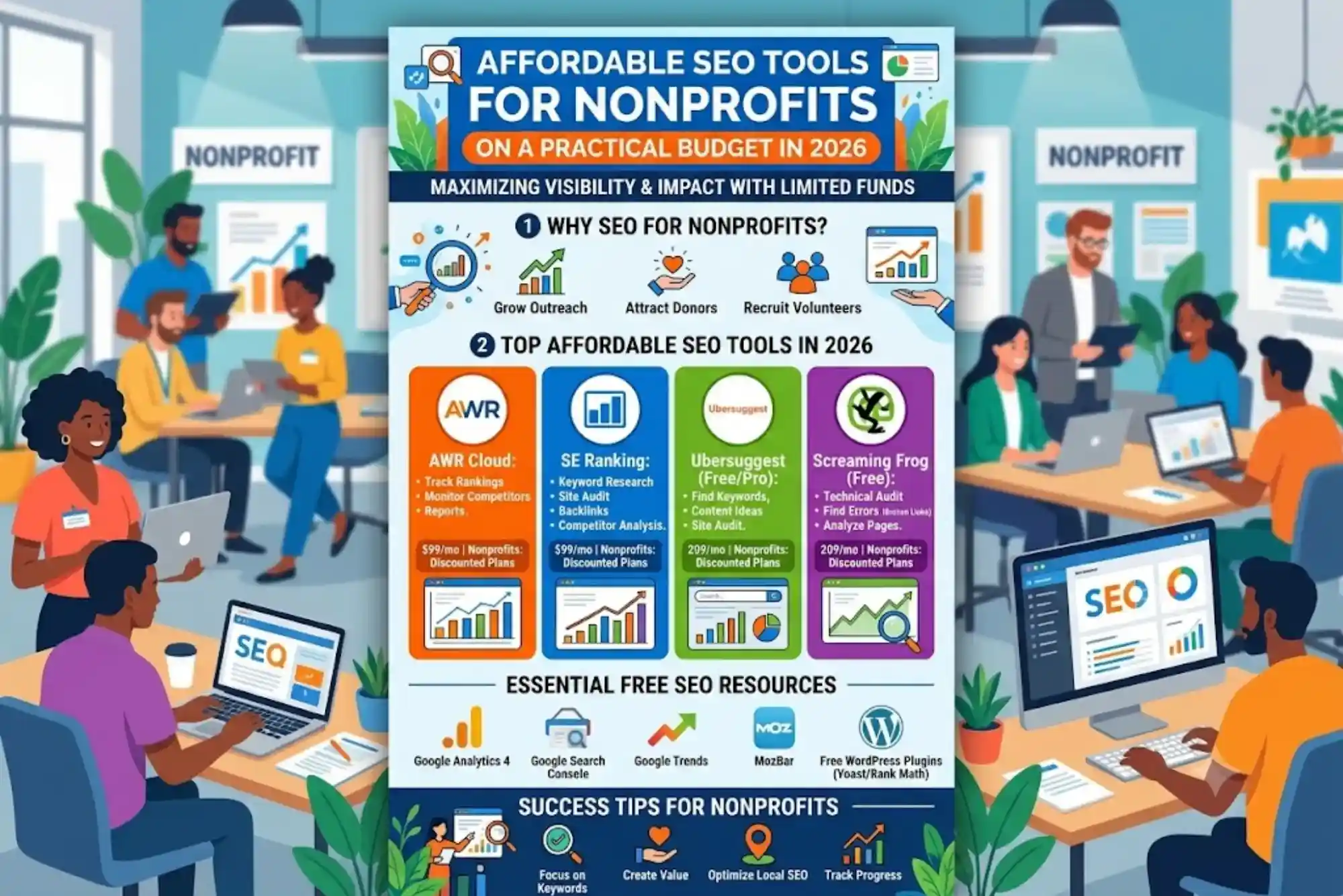
Affordable SEO Tools for Nonprofits: The Short Answer
The best affordable SEO tools for nonprofits in 2026 are not necessarily the most expensive all-in-one platforms. A practical setup can combine free tools for search performance and analytics with low-cost or free solutions for keyword research, technical audits, content optimization, and local visibility. The key is choosing tools that solve specific problems and using them consistently rather than paying for features a small team never needs.
Why SEO Matters for Nonprofits With Limited Budgets
For many nonprofits, the challenge is not a lack of meaningful stories or valuable services. It is being discovered by the people who need them. A charity may provide food assistance, educational programs, healthcare support, environmental initiatives, or community services, yet still struggle to reach potential donors, volunteers, beneficiaries, and partners online.
Search engine optimization can help close that visibility gap. When a nonprofit creates useful content around the questions its audience actually searches for, improves its website structure, and measures organic traffic properly, it can build a sustainable source of visibility without relying entirely on paid advertising.
That does not mean every nonprofit needs an expensive enterprise SEO platform. In fact, smaller organizations often benefit from a simpler approach. A communications manager who understands search intent and has access to reliable data can accomplish a great deal with a small collection of affordable SEO tools.
The goal is to spend money where it creates measurable value. A nonprofit should be able to explain why a tool is needed, which SEO problem it solves, and how the information it provides will influence decisions.
What to Look for in Affordable SEO Tools for Nonprofits
Budget-friendly SEO software should be judged on usefulness rather than the number of features listed on a pricing page. A platform that offers hundreds of reports is not necessarily better than a focused tool that helps a small team identify its most important opportunities.

Before subscribing to any SEO platform, consider these factors:
- Free functionality: Look for tools that provide meaningful data without requiring an expensive subscription.
- Ease of use: Nonprofit teams often have limited time and may not include a dedicated SEO specialist.
- Actionable insights: Data is valuable only when it helps the team decide what to improve next.
- Keyword research: The tool should help identify realistic search opportunities rather than only showing high-volume terms.
- Technical auditing: Basic checks for broken links, indexing issues, redirects, and page problems can prevent avoidable SEO losses.
- Reporting: The ability to demonstrate progress to leadership and funders can make SEO investment easier to justify.
- Scalability: A good tool should remain useful as the nonprofit’s website and content program grow.
It is also worth checking whether a nonprofit qualifies for discounts, grants, or special access programs before paying standard commercial rates. Eligibility requirements vary by provider, so organizations should verify current terms directly with each vendor.
Best Affordable SEO Tools by Function
Google Search Console for Organic Search Performance
Google Search Console should be one of the first tools in a nonprofit’s SEO toolkit. It provides valuable information about how a website appears in Google Search, including queries that generate impressions and clicks, pages receiving search traffic, indexing status, and certain technical issues.
For a nonprofit working with a limited budget, this information can shape an effective content strategy without requiring a premium SEO subscription. The team can identify pages already gaining visibility and improve them, discover queries where the organization appears but receives few clicks, and monitor whether important pages are being indexed.
The biggest advantage is that the data comes directly from Google’s search ecosystem. It should not replace broader keyword research or technical analysis, but it provides a strong foundation for understanding organic performance.
Google Analytics for Measuring Website Outcomes
SEO traffic is only useful when it contributes to meaningful organizational goals. Analytics software can help nonprofits understand what visitors do after arriving from search engines.
Depending on the organization’s objectives, useful conversions may include donation completions, volunteer applications, newsletter subscriptions, event registrations, contact form submissions, or downloads of important resources.
Tracking these actions helps move SEO reporting beyond vanity metrics. A page receiving thousands of visitors may be less valuable than a smaller page that consistently generates qualified volunteer inquiries or donations.
Google Keyword Planner for Basic Keyword Research
Keyword research does not have to begin with an expensive SEO suite. Google’s keyword research ecosystem can help organizations explore search terms related to their causes, services, campaigns, and locations.
Nonprofits should focus on understanding search intent rather than chasing the largest possible search volume. For example, a local food bank may find more value in content addressing specific questions about food assistance eligibility than in trying to rank for an extremely broad term such as “charity.”
Useful keyword research questions include:
- What problems does our audience search for?
- What questions do beneficiaries ask before seeking help?
- Which services or programs need greater visibility?
- What local searches could bring qualified visitors?
- Which topics can our organization answer with genuine expertise?
Free SEO Audit and Technical Analysis Tools
Technical SEO can sound complicated, but nonprofits do not always need enterprise crawling software to identify basic problems. Several free or low-cost auditing solutions can help teams inspect pages for common issues such as broken links, missing metadata, duplicate page elements, slow-loading resources, and other technical concerns.
The important point is to use these tools selectively. Running an audit is not the same as completing an SEO project. A report filled with hundreds of warnings can overwhelm a small team. Prioritize issues that affect important pages, search accessibility, user experience, and conversions.
For example, fixing a broken link on a major donation page is usually more valuable than spending hours correcting a minor issue on an obscure archive page.
Low-Cost Keyword Research Platforms
When a nonprofit has moved beyond basic keyword research, a low-cost SEO platform may be useful for discovering related search terms, analyzing competitors, reviewing ranking trends, and identifying content gaps.
The right choice depends on the size of the website and the team’s workflow. Some organizations may need only occasional keyword research, while others publish content every week and require ongoing monitoring.
Before subscribing, compare the actual limits that matter: keyword searches, tracked keywords, projects, users, historical data, and reporting capabilities. A lower monthly price is not necessarily a bargain if the plan restricts the functions the organization uses most.
How to Build a Practical Nonprofit SEO Tool Stack
A nonprofit does not need to purchase every tool at once. A staged approach is usually more sustainable and easier to manage.
| SEO Need | Budget-Friendly Approach | Primary Purpose |
|---|---|---|
| Search performance | Free search performance platform | Monitor queries, clicks, impressions, and indexing |
| Website analytics | Free analytics platform | Measure traffic and conversions |
| Keyword discovery | Free keyword research options | Find relevant topics and search queries |
| Technical SEO | Free audits and webmaster tools | Identify important technical problems |
| Content planning | Spreadsheets and keyword data | Organize topics and publishing priorities |
| Advanced research | One affordable paid SEO platform | Competitor analysis and deeper keyword research |
This approach allows the organization to establish a reliable baseline before adding paid software. Once the team understands its SEO workflow, it becomes easier to identify where a subscription would save time or provide data that free tools cannot.
How to Use SEO Tools Without Overspending
The most practical nonprofit SEO strategy is often a combination of technology and disciplined processes. Tools should support the team’s work, not become the work itself.
Start With One Clear Objective
Choose a measurable objective before opening an SEO platform. It could be increasing organic visibility for a specific service, attracting more local volunteers, growing recurring donations, or improving visibility for educational resources.
A defined objective makes it easier to decide which data matters. It also prevents the team from spending valuable time exploring reports that do not influence decisions.
Prioritize Existing Pages Before Creating Hundreds of New Ones
Many nonprofits already have useful content that receives some search visibility. Updating these pages can be more efficient than publishing a large volume of new articles.
Look for pages that rank on the second page of search results, receive impressions but few clicks, or answer important questions but lack sufficient detail. Improving these assets may require less time than starting from scratch.
Create Content Around Real Audience Questions
Keyword data is most useful when combined with knowledge from the people working directly with the nonprofit’s audience. Staff members, volunteers, support teams, and program managers often know the questions that potential beneficiaries ask repeatedly.
Those questions can become excellent content topics. A nonprofit can create practical guides, explainers, eligibility information, resource pages, case studies, and educational content that directly addresses user needs.
That combination of search data and first-hand organizational expertise is often more valuable than simply copying competitor content.
Review SEO Performance Monthly
Nonprofits rarely need to monitor every SEO metric every day. A monthly review is often sufficient for smaller organizations.
A simple report can compare organic clicks, impressions, important landing pages, conversions, and progress toward specific goals. Teams can then choose a small number of actions for the following month.
This creates a sustainable cycle: measure, prioritize, improve, and measure again.
Common SEO Mistakes Nonprofits Should Avoid
Limited budgets make prioritization especially important. Several common mistakes can waste both money and staff time.
- Buying too many tools: Multiple subscriptions often provide overlapping data.
- Focusing only on rankings: Rankings matter, but traffic and meaningful conversions are closer to organizational outcomes.
- Targeting overly broad keywords: Highly competitive terms may consume resources without producing qualified visitors.
- Ignoring local SEO: Organizations serving specific communities should make location information clear and consistent.
- Publishing without a strategy: More content does not automatically mean better organic performance.
- Ignoring technical issues: Poor indexing, broken links, and difficult navigation can undermine otherwise strong content.
- Failing to update successful pages: Valuable content can lose relevance as information changes.
One particularly common problem is treating SEO as a one-time project. Search visibility develops over time. A modest but consistent monthly process is usually more realistic for a nonprofit than an intensive campaign followed by months of inactivity.
How Nonprofits Can Measure SEO ROI
Measuring return on investment can be challenging when an organization has multiple objectives. The answer depends on what the nonprofit is trying to achieve.
For fundraising organizations, SEO performance might be evaluated through organic donation conversions and recurring donor growth. For service organizations, the focus may be qualified inquiries, applications, or resource downloads. Advocacy groups may prioritize newsletter subscriptions, campaign participation, or event registrations.
A useful measurement framework separates three levels of performance:
- Visibility: Impressions, rankings, and search presence.
- Engagement: Organic clicks, engaged visits, and relevant landing-page activity.
- Outcomes: Donations, registrations, volunteer applications, inquiries, or other meaningful actions.
This approach helps nonprofit leaders understand why SEO deserves attention. The purpose is not simply to generate more website visits. It is to connect people who are searching for information with the organization’s mission and services.
Can Free SEO Tools Be Enough for a Small Nonprofit?
Yes. A small nonprofit can often build a functional SEO process using free tools for search performance, analytics, keyword discovery, and basic technical checks. The main limitation is usually not the absence of software but the availability of time and expertise.
Paid tools become more valuable when they save significant research time, provide advanced competitor insights, automate reporting, or support a larger content operation. The decision should be based on the value of those capabilities rather than the assumption that paid software automatically produces better rankings.
Are SEO Tools Worth Paying for When Budgets Are Tight?
They can be, but only when the tool solves a specific problem that matters to the organization. A nonprofit publishing regularly may benefit from a paid platform that reduces hours of manual keyword research. Another organization with a small website and occasional content needs may find that free tools are sufficient.
The strongest approach is to start with free resources, establish a repeatable process, and upgrade only when a clear limitation appears.
Frequently Asked Questions
What are the best affordable SEO tools for nonprofits?
The best options depend on the nonprofit’s needs, but a practical starting point includes free search performance and analytics platforms, basic keyword research tools, and free technical auditing resources. A low-cost all-in-one platform can be added later when advanced research or reporting becomes necessary.
Should nonprofits spend money on SEO software?
Not necessarily. Many organizations can achieve meaningful SEO improvements with free tools and consistent execution. Paid software is most useful when it saves staff time, provides deeper competitive research, or supports a growing content and reporting program.
How much should a nonprofit budget for SEO tools?
There is no universal amount. The right budget depends on website size, staff capacity, publishing frequency, and organizational goals. A small nonprofit can begin with a mostly free tool stack and introduce one paid platform only when its benefits can be measured.
What should nonprofits track for SEO success?
Nonprofits should track metrics connected to their mission, including organic traffic, search visibility, important landing pages, and conversions such as donations, volunteer applications, registrations, inquiries, or resource downloads.
Final Thoughts on Affordable SEO Tools for Nonprofits
Affordable SEO tools for nonprofits can provide substantial value when they are used as part of a focused strategy rather than treated as a shortcut to higher rankings. The strongest budget approach is to begin with free data sources, understand the audience’s search behavior, improve existing content, resolve important technical problems, and measure outcomes that matter to the organization.
For many nonprofits, the smartest SEO investment is not a large collection of expensive subscriptions. It is a simple system that the team can maintain month after month. One reliable search performance platform, one analytics solution, practical keyword research, occasional technical audits, and a clear content plan can create a strong foundation.
As the organization’s organic presence grows, paid tools can be introduced strategically. The objective should always remain the same: help the right people discover useful information, connect with the nonprofit’s mission, and take meaningful action.
[Insert relevant reference link here]
Internal Links
Related Reading: Free vs Paid SEO Tools for Nonprofits: Which Option Makes More Sense in 2026?
Related Reading: Best All-in-One SEO Tools for Nonprofits in 2026: What to Use and Wh

